Showing posts with label Economic growth. Show all posts

Tuesday, March 01, 2011

Canada: The Destination Spot

Sheridan College Campus PM Economic Action Plan
Will Canada benefit from the luck of the Irish? Canada is starting to see the early signs of the low tax policy. Our PM and his team have been spreading the message at home and abroad. Canada is the place to invest and raise a family. Is it too much to ask the opposition parties that are so busy talking down our country and our government at every opportunity at home or over seas to give it a rest? It is a shame the opposition MPs appear to be in it for themselves.

Our state broadcaster believes they are reporting a balanced program
It is not enough for our MSM to air insignificant issues for weeks. Perhaps they feel it necessary to give the opposition parties free publicity to air their talking points as news to level the playing field. The ratings speaks volumes, we have tuned out the noise.
"Worldwide, [Canada] is looking like the superstar of how to manage your economy," said Eamonn O'Loghlin, executive director of the Ireland Canada Chamber of Commerce. "So you have all these young, educated, highly skilled people in Ireland who are suddenly in a situation where there are very few jobs. They're looking around and they see how Canada has come through the recession and they see more opportunity here." - A new wave of young Irish workers head for Canada


Investment in capital construction and machinery and equipment is expected to rise 3.3% in 2011 to $349.1 billion.
Much of the recovery from the 2009 economic downturn occurred in 2010 due to strong growth on the part of both public (+17.5%) and private (+8.0%) investment. If intentions are realized, increases in 2011 will be led by private investment, which is expected to grow 3.8% to $261.3 billion.
Significant private capital spending intentions are anticipated from the mining and oil and gas extraction sector, which is expected to grow 11.4% to $53.0 billion. -Private and public investment

Industry Minister Tony Clement, PM Stephen Harper at Plant F35 jobs
...the federal corporate tax reduction is great policy. As I estimated last year, the three-point reduction in the corporate rate would lead to an increase in capital investment of about $50-billion within seven years. A $100-million annual revenue loss that can generate that much new capital expenditure is a slam-dunk in policy terms. Why Liberals are wrong on 6% tax hike to job creators

Will the media question the opposition MPs and pundits with facts about the global economy and how Canada is leading the G7? Will the media act in a non partisan manner and be skeptical again?


Thursday, October 14, 2010

Is Canada too successful for a U.N. security seat?

UN Security Council Chamber in New York.
Examine the articles why allies and friendly nations failed to deliver the necessary votes for Canada to secure a temporary seat:  ENVY or National interest?
  1. Canada's effort in blocking the Global Bank Tax.
  2. Push for developing nations to be included in Carbon emission program: Third party audits of Carbon Credits of China/India in Copenhagen.
  3. Canada's unwavering support for only democracy in Middle East: Israel.
  4. Canada can't be pushed around, it's economy is not a basket case. We 're number  one in G8.
  5. Canada's call for more Accountability at G8/G20, U.N.
Canada is pushing for more economic sanctions against Iran. The United States is being isolated from it's natural ally on the Security Council, European countries have  gained two more seats. Will the Totalitarian regimes have an easier time without Canada at table?
The U.S. could use the help in pushing for U.N. reform and advocating pro-democracy policies. The current conservative government in Canada had been campaigning for months to sit on the U.N.’s most powerful committee with no public support from the Obama administration.Germany, Portugal: That gives the EU more than 25% control of the body and a strong voting block to ensure EU priorities become global priorities. -- This was the second time a high profile ally could have used U.S. help yet Rice chose to stay silent. 

The Democrat led Congress and Senate have been unsuccessful in legislating a Cap and Trade Regime.  They have enacted regulations from EPA. United States November elections point to a loss at the Senate or Congress by Democrats. This will reduce the ability for the Obama administration to enact a Carbon Tax.
English: Number of resolutions vetoed by each ...
Vetoes
China, India and Brazil have a lower standard on observing, protecting human rights and freedom of the press at home or in foreign trade. They could use one less boyscout at the Security Council who would raise concerns.
India’s most important priority at the UN is to be asked to join the Security Council as a permanent member. Portugal supports that campaign.
Canada opposes expanding the number of permanent members, any one of whom can veto a resolution. Instead, it supports an expanded and regionally representative group of non-permanent members on the council.
 
“As the structure of the world economy changes, more and more, we are in a position to co-operate for our mutual benefit,” Mr. Harper said in a speech Wednesday to a large gathering of Chinese and Canadian business leaders, diplomats and academics.
“China needs a stable source of energy to fuel its continuing growth; Canada is an emerging energy superpower,” Mr. Harper added.
“In other words, in the context of global economic developments, it is clear that the strategic partnership between Canada and China has never been more promising. Our countries have both performed relatively well in the global recession, and we have been on the right side in the crucial deliberations in the G20 over the past two years.”
Developing Nations need Commodities Canada is Ethical Energy Super Power
The currency’s latest surge comes as prices for gold approaches a record while crude prices advanced. Finance Minister Jim Flaherty’s comments Tuesday are also lifting the loonie – he expects Canada will be the first G7 country to erase its deficit. Meantime, the U.S. dollar continued to slide after minutes yesterday from the Federal Reserve showed new stimulus will be needed to kick-start growth..
Robin Hood Tax Part II
Oxfam is pushing for a financial transactions tax as a means to pay for environmental programs and foreign aid.
Prof. Stiglitz, who teaches at Columbia University in New York, said on a conference call that such a levy would raise considerable sums because there would be little incentive to dodge a small fee on transactions. The money would come from volume.
The tax would be fairly easy to collect since most of these transactions flow through computer systems and clearing houses, Prof. Stiglitz said. The financial crisis created the need to curb certain kinds of financial behaviour, and a tax would help achieve that, he said. Arguments by the banking industry that a transactions tax would hurt growth are “self-serving,” Prof. Stiglitz said, arguing that a more stable financial system would enhance economic growth.
The “currency war” also argues for a financial transactions tax: since many emerging market countries are putting up tariffs or controls on capital flows to control the ascent of their exchange rates, all countries might as well do it in a co-ordinated way. Not that all countries need to enact the tax for it to work – Prof. Stiglitz said he saw no “compelling reason why this needs to be done globally,” noting countries that opted to implement a financial transactions tax would benefit from a smoother, more stable financial sector. 
PM meets with official opposition
It was National interest on the part of many nations who policies and interests do not match ours. Should we be ashamed we stuck to our principled positions? With a four point lead nationally and a six point lead in Ontario, not bloody likely.
Opposition ignore abuses in some developing countries
It appears some in the media and opposition's need to belong outweighs their principles in human rights and Canada's national interest. As mentioned our economy is the "envy of the world". What country can match us?
Enhanced by Zemanta

Thursday, July 29, 2010

Good News Canada: Bad News Liberal Express

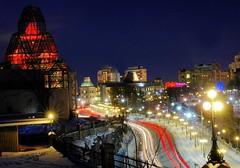
National Gallery of Canada and Environs, Ottawa.Image by Robbie's Photo Art via Flickr

More bumps for the Liberal Express. Can someone page  Peter Donolo for talking points to talk down the good news on the Liberal Express.

When the financial crisis and recession began, Canada was in much better fiscal shape than almost any other industrial country. The federal government and some provinces spent a decade slowly paying down debt. The federal debt-to-GDP ratio declined from 68 per cent in FY1995-96, to just 29 per cent in 2008-09. Most provinces also saw an improvement in the public debt load.

In comparison to the federal outlook, provinces, most notably Ontario, now face a structural fiscal challenge. During good economic times earlier in the decade, many provinces ramped up expenditures on priorities such as health care. In this area, spending increased by an average of 7 per cent annually over the last five years. 

Notwithstanding the structural fiscal challenges of the provinces, Canada is in a much stronger fiscal position than almost every other industrial country. This bodes well for the performance of the Canadian economy as we navigate through stormy global seas. - Canadian Feds Ahead of Plan on Fiscal Re-balancing


This will be another story on the economy that won't get significant attention in our mainstream news. Instead they will look for spinning negative stories to push their own agenda.


The provinces need to reign in their spending.


Enhanced by Zemanta

Saturday, April 10, 2010

Government of Canada Priorities: Jobs, Recovery

Estimates of potential GDP are crucial for monetary and fiscal policymakers who require estimates of the economy’s capacity to gauge inflationary pressures and to assess the budgetary position over the business cycle. Unfortunately, an economy’s potential GDP and output gap are not directly observable and therefore must be estimated. Fortunately the Department of Finance and the Bank of Canada construct estimates of potential GDP which are used in their respective policy analyses and deliberations.

However, given the absence of published estimates over the forecast horizon 2008-2013, it is necessary to construct them.
Future potential growth is assumed at 2.4% annually and an upper bound of 2.7% and lower bound of 2.1% are also considered. This range is consistent with estimates of potential growth provided by private sector forecasters and the Bank of Canada. -The Budgetary Balance and the Economic Cycle December 18, 2008

March 6, 2009 - Global fiscal stimulus is essential now to support aggregate demand and restore economic growth. The International Monetary Fund has called for fiscal stimulus in as many countries as possible, including emerging market and advanced economies. This paper uses simulations with a multi-country structural model to show that worldwide expansionary fiscal policy combined with accommodative monetary policy can have significant multiplier effects on the world economy.-INTERNATIONAL MONETARY FUND


July 6, 2009 - Given the revised economic outlook, updated assumptions, and announced post-budget measures, PBO is now projecting cumulative budgetary deficits of $155.9 billion over the 5-year projection period 2009-10 to 2013-14. The budget deficit is expected to peak at $48.6 billion (3.2 per cent of GDP) in 2009-10, improving to $16.7 billion (0.9 per cent of GDP) by 2013-14. Economic and Fiscal Assessment

November 2009 - Reflecting the better-than-expected employment performance since May and upward revisions to real GDP growth, private sector forecasters have revised down their outlook for the unemployment rate in the near term (Table 1-4). Based on the September 2009 PBO survey, forecasters expect the unemployment rate to average 8.4 per cent in 2009 and 8.9 per cent in 2010 – lower than the 8.7 per cent and 9.4 per cent, respectively, expected in the June survey. Economic Fiscal Update


April 9, 2010 -  March’s employment increase brings total gains to 176,000 (+1.1%) since July 2009. Employment edged up by 18,000 in March, continuing an upward trend that began in July 2009. The unemployment rate remained unchanged at 8.2%.- Labour Force Survey


April 10, 2010 - Where the Helena Guergis media frenzy is most beneficial to Liberals is that it is distracting attention away from our sensational economic recovery. - The Iceman This story should be shouted from the rooftops because it affects every Canadian unlike other stories that the Lame Stream Media's been focused on lately. - Chasing Apple Pie


Priorities can be a problem for some political parties.
CanadianSense You tube

CanukPolitics You tube


Enhanced by Zemanta

Monday, March 01, 2010

Jim Flaherty 1 - Kevin Page 0

The economy boomed back in the fourth quarter of last year, pushing well past expectations and raising the likelihood that the Bank of Canada will start to raise interest rates by summer.
Real gross domestic product grew at an annual rate of 5% in the fourth quarter, a full point above what analysts had expected and the largest quarterly increase in nearly a decade.
It outstripped the Bank of Canada’s forecast of 3.3% growth on an annual basis. The central bank has its next scheduled announcement on key lending rates on Tuesday but observers expect its overnight rate will remain where it is, at an all-time low of 0.25%.
The Bank of Canada and other central banks, particularly the U.S. Federal Reserve, have kept their key lending rates at, or near, the lowest levels possible in order to reduce the cost of borrowing and stimulate spending.
Canada’s economy grew by 1.2% in the fourth quarter, the largest jump since the third quarter of 2000, Statistics Canada reported.
Real GDP, a closely watched inflation-adjusted measure of economic performance, increased 0.6% in December alone, a fourth straight monthly advance.
Economist Douglas Porter of BMO said the data marked a clean break from the recession that began to be felt in Canada in October 2008.
The Bank of Canada essentially declared that the recession ended last summer -- a stance that was hotly debated in the months that followed, particularly because unemployment remained high and GDP increased minimally.
Background:
Kevin Page issued a Economic and Fiscal Assessment on November 2008. Report here
Kevin Page predicted a small deficit and laid out three options.
  1. Stay the course offer NO big spending increases.
  2. Auction off Crown assets or increase taxes or both to return to a balanced budget.
  3. Increase spending to stimulate the economy in the short term. The report says this could provide a buffer if a slowdown is expected to be "particularly severe," but would weaken the government's fiscal position in the short and long term.
Some of us disagreed with the third option in a massive stimulus budget suggesting it was NOT a conservative budget and betrayed the conservative principles. Some of us were concerned the significant increase of spending, 
speed would creat problems.
 
The Budget 
( December 2008 G8 and Canadian Premiers Advocated)
In March 2009 the Liberals allowed the largest budget to pass which was "Option 3" as proposed by the CPC led government. The only condition from the Liberals was to have the government provide quarterly reports. The NDP had already promised to vote it down before reading it, so in keeping their word the NDP did. The Bloc did not feel it had enough money for Quebec and also voted against the massive stimulus.
Most of 2009 we had the pleasure of watching the political parties create an industry of photo-ops, publicity stunts to attack each other without debating serious issues.
  • Exit strategy Afghanistan Mission?
  • Plans for Deficit Reduction, Balanced Budget for adopting "Option 3" in 2009?
The Budget March 2010
As the Olympic Games ends, we are going to be witness to the political parties in Ottawa provide further evidence why Canadians in larger numbers continue to tune them out.
Enhanced by Zemanta